Green and brown
Every compost heap is a balancing act between two kinds of material. Get the ratio roughly right and the heap does the work.

Hands-on tests
- Squeeze test — drips freely = too wet; won't hold shape = too dry; damp and springy = about right
- Temperature check — a warm centre means the carbon-to-nitrogen balance is close enough for active breakdown
- Smell test — ammonia = too much nitrogen/too wet; no smell, no change = too dry or too woody
Reading what you've got
Composting microbes need carbon for energy and nitrogen to build proteins. Carbon comes from dry, brown, woody things — cardboard, straw, dead leaves, scrunched paper. Nitrogen comes from wet, green, fresh things — grass clippings, vegetable peelings, coffee grounds, fresh weeds. You don't need to measure either. Your hands and nose will tell you what the heap is short of.
Too much nitrogen and the heap turns slimy, smells of ammonia, and collapses into a wet mat. Too much carbon and it just sits there, pale and dry, doing nothing for months. The classic advice is roughly one part green to two or three parts brown by volume — not weight. In practice, the standard mistake is adding too many grass clippings at once without anything to break them up. One barrowload of clippings layered with torn cardboard or dry leaves will compost; the same clippings tipped in alone will compact and smell within a week.
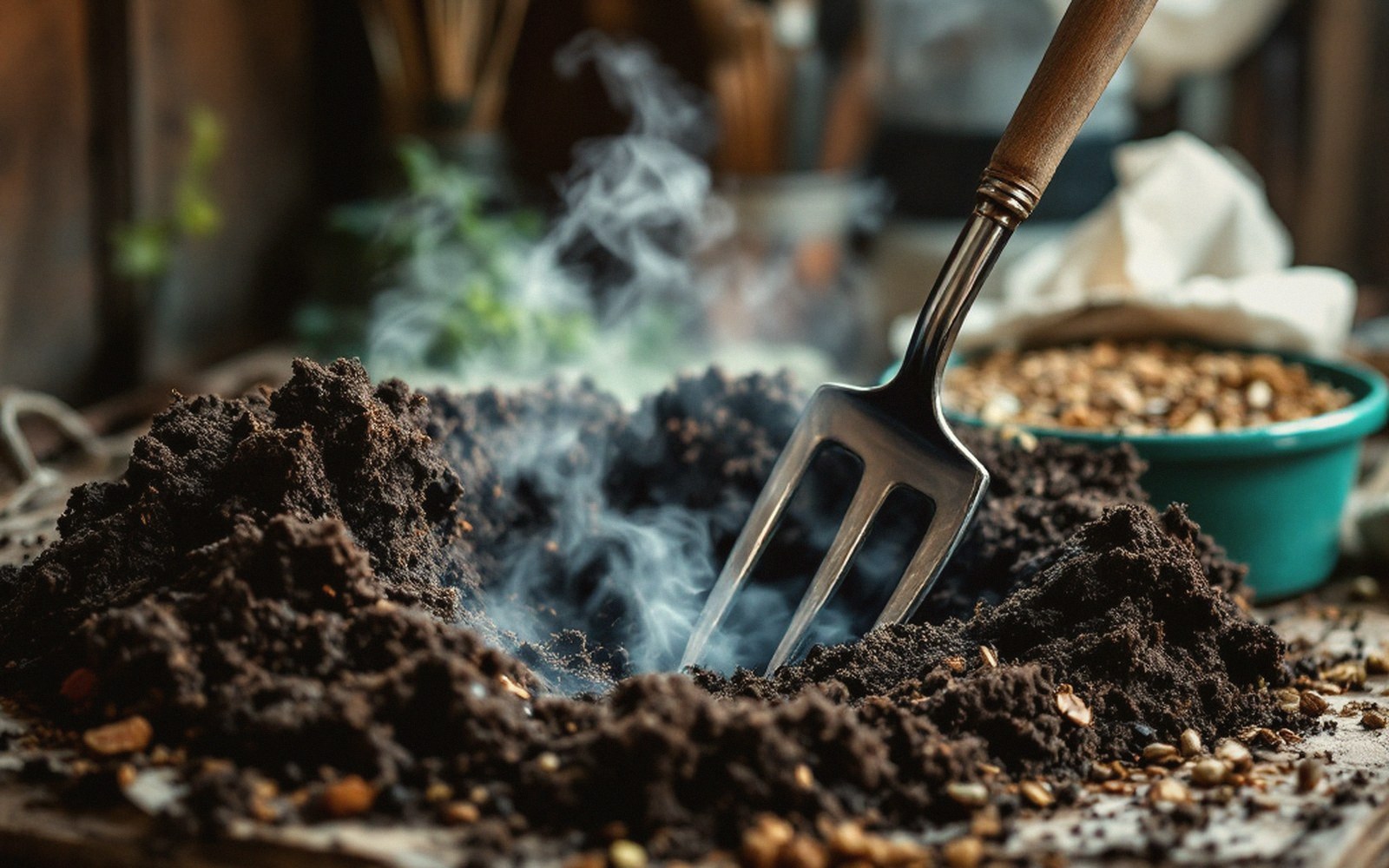
Pick up a handful from the middle of the heap. Squeeze it. If water drips freely, it's too wet — add browns and turn it. If it won't hold together at all and feels powdery, it's too dry — add greens or water it lightly before turning. A heap in good balance feels like a wrung-out sponge: damp, springy, and faintly warm. The warmth is the real sign that the carbon-to-nitrogen ratio is close enough for the microbes to get on with it.
A few materials confuse the categories. Cardboard counts as brown even when it's printed. Coffee grounds count as green despite being brown in colour. Fresh wood chip is brown but a useful one — coarse enough to keep air pockets open while feeding the process slowly. Autumn leaves fall between: mostly brown, breaking down slowly enough that they're better saved separately and turned into leaf mould rather than buried in an active heap.
None of this needs precision. The heap will tell you what it wants. A bad smell is a message — too wet, or too much nitrogen. No warmth and no change is another — too dry, too woody, or both. Adjust, turn, and check again in a week. Compost chemistry runs on the same feedback loop as any other practical skill: you act, you look, you correct. The terminology is there to explain what you're already sensing.
Where we stop
No mains electricity, gas, water mains, boilers, flues, roofs, ladders past single storey, structural work or anything requiring a qualified person. If a job could hurt somebody, it is not in this register.